
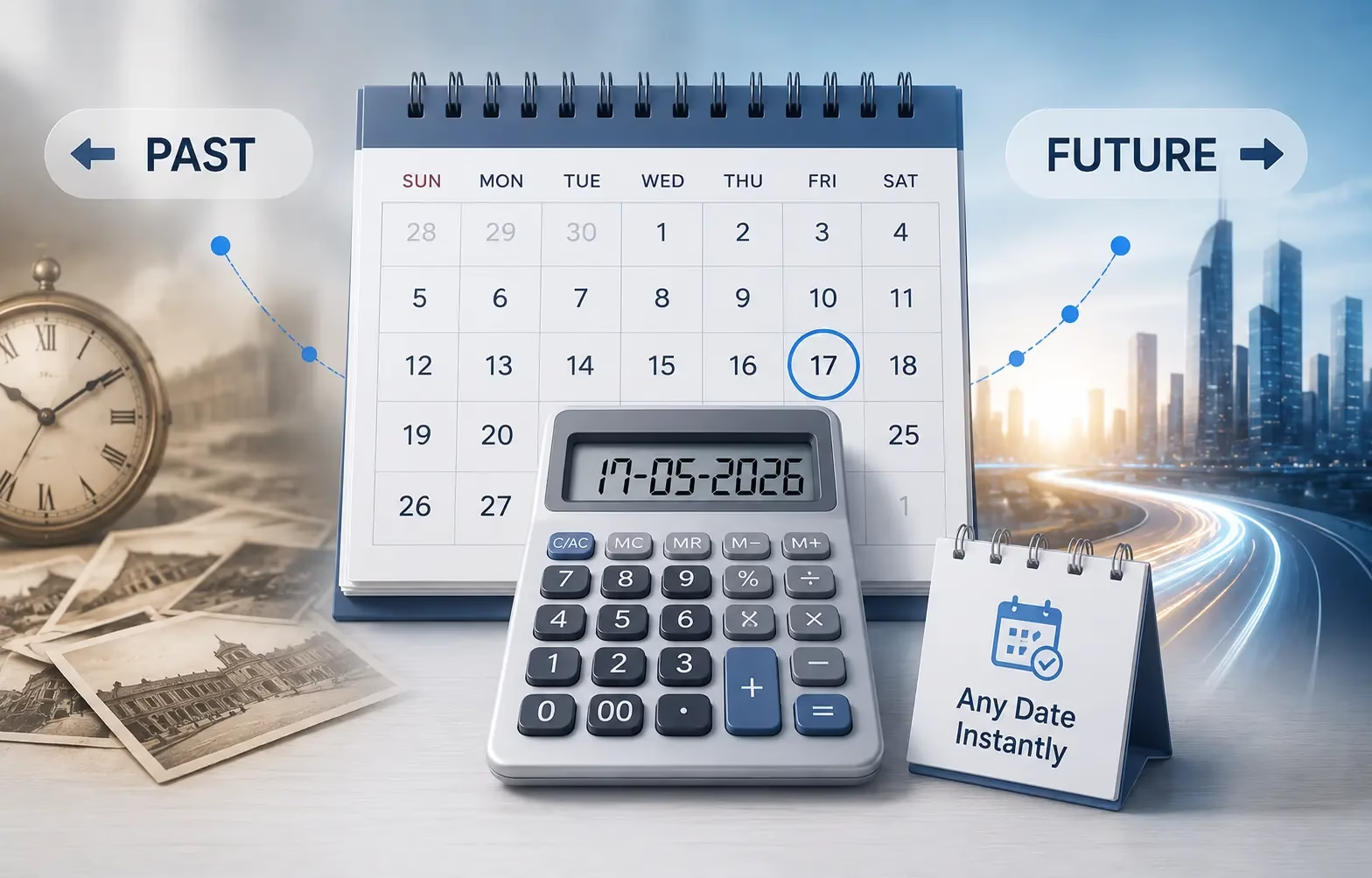
Future and Past Date Calculator — Find Any Date Instantly
A future and past date calculator is one of the most practical tools you can have for everyday planning. Whether you need to find a date 90 days from now, figure out what date fell 60 days ago, plan a project deadline weeks from now, or calculate when a warranty expires, this tool gives you the exact answer in seconds.
This guide explains how a future date calculator and a past date calculator work, how to use them for both forward and backward date finding, what the most common use cases are, and how to get the most accurate results every time you use one.
What Is a Future and Past Date Calculator
A future and past date calculator is a free online tool that finds the exact date that results from adding or subtracting a specific number of days, weeks, months, or years from any starting date you choose.
The future date function counts forward from your starting date and returns the date that falls the specified duration in the future. The past date function counts backward from your starting date and returns the date that falls the specified duration in the past.
Both functions use the Gregorian calendar as their foundation, accounting for variable month lengths, leap year February dates, and year transitions automatically. The result always includes the exact calendar date and the day of the week it falls on.
How a Future Date Calculator Differs From a Days From Today Calculator
A days from today calculator always uses today as the automatic starting point. A future date calculator lets you choose any starting date, not just today. This makes it more flexible for situations where you need to find a date relative to a specific past or future reference point rather than the current date.
For example, a days from today calculator answers: what date is 90 days from today? A future date calculator answers: what date is 90 days from March 15, 2026, which may be a contract signing date, an invoice date, or any other reference point you specify.
How to Use a Future Date Calculator: Step by Step
Using a future date calculator takes only a few seconds once you have your starting date and duration ready.
Step One: Enter Your Starting Date
Type your starting date into the calculator. This can be today’s date, a past date such as a contract signing date, or a future date such as an upcoming event. Use the correct format required by the tool, typically MM/DD/YYYY or DD/MM/YYYY.
Step Two: Choose the Duration to Add
Enter the number of days, weeks, months, or years you want to add. Some calculators allow you to combine units, for example, adding 2 months and 15 days simultaneously. Choose the unit that matches how your deadline or period is expressed.
Step Three: Read the Result
The calculator returns the exact future date and the day of the week it falls on. For example, adding 90 days to January 1, 2026, gives April 1, 2026, which is a Wednesday. Adding 6 months to January 1, 2026, gives July 1, 2026, which is a Wednesday as well.
Step Four: Verify and Use the Result
Use the result date for your planning purposes, whether that is setting a deadline, scheduling a follow-up, calculating an expiry date, or any other time-sensitive task.
How to Use a Past Date Calculator: Step by Step
Our past date calculator works in the same way as a future date calculator, but subtracts time instead of adding it.
Step One: Enter Your Starting Date
Enter the date you want to count backward from. This is typically today’s date if you want to know what date fell a specific number of days ago, or a known end date if you want to find when a period started.
Step Two: Choose the Duration to Subtract
Enter the number of days, weeks, months, or years to subtract. The calculator counts backward from your starting date by the specified duration.
Step Three: Read the Result
The calculator returns the exact past date and the day of the week it fell on. For example, subtracting 30 days from April 25, 2026, gives March 26, 2026, which is a Thursday. Subtracting 6 months from April 25, 2026, gives October 25, 2025, which is a Saturday.
Future Date Calculator: Real Examples for Common Scenarios
Here are practical examples showing how a future date calculator gives exact results for common planning situations.
Example One: Contract Payment Due Date
A contract is signed on February 10, 2026. The payment terms specify net-60, meaning payment is due 60 days after signing. Adding 60 days to February 10, 2026: February has 28 days in 2026, so from February 10 to February 28 is 18 days. 60 minus 18 equals 42 days remaining. March has 31 days. 42 minus 31 equals 11 days remaining. Count 11 days into April: April 11, 2026.
Payment due date: April 11, 2026, which is a Saturday. Since this falls on a weekend, the actual due date for most contracts would be the next business day, April 13, 2026, which is a Monday.
Example Two: Product Warranty Expiry
A product is purchased on March 5, 2026. The warranty covers 1 year from purchase. Adding 1 year to March 5, 2026, gives March 5, 2027, which is a Friday. The warranty expires on March 5, 2027.
Example Three: Medical Follow-Up Appointment
A patient has surgery on April 10, 2026. The surgeon schedules a follow-up appointment 6 weeks later. Adding 6 weeks, which is 42 days, to April 10, 2026: April has 30 days, so from April 10 to April 30 is 20 days. 42 minus 20 equals 22 days remaining. Count 22 days into May: May 22, 2026.
Follow-up appointment: May 22, 2026, which is a Friday.
Example Four: Subscription Renewal Date
A subscription starts on January 15, 2026, with a 3-month free trial. Adding 3 months to January 15, 2026, gives April 15, 2026, which is a Wednesday. The free trial ends on April 15, 2026, and billing begins on that date unless the subscription is cancelled before then.
Past Date Calculator: Real Examples for Common Scenarios
Here are practical examples showing how a past date calculator finds specific past dates.
Example One: Finding a Contract Start Date From an End Date
A contract ends on June 30, 2026, and ran for exactly 2 years. Subtracting 2 years from June 30, 2026, gives June 30, 2024, which is a Sunday. The contract started on June 30, 2024.
Example Two: Finding the Date of a Medical Diagnosis
A patient is told that their current symptoms have been present for 45 days. Today is April 25, 2026. Subtracting 45 days from April 25, 2026: April has 25 days to count back through, leaving 20 more days to subtract. March has 31 days. Go back 20 days from March 31: March 11, 2026.
The symptoms began on March 11, 2026, which was a Wednesday.
Example Three: Finding the Start of a Promotional Period
A promotional discount is ending on May 31, 2026, and has been running for 90 days. Subtracting 90 days from May 31, 2026: May has 31 days, so from May 31, counting backward through May, is 30 days. 90 minus 30 equals 60 days remaining. April has 30 days. 60 minus 30 equals 30 days remaining. March has 31 days. Go back 30 days from March 31: March 1, 2026.
The promotion started on March 1, 2026, which was a Sunday.
What Date Will It Be in X Days, Weeks, Months, or Years
Our future date calculator answers this question for any duration. Here is a quick reference showing future dates for common periods from today, April 25, 2026.
- 7 days from today is May 2, 2026, a Saturday.
- 14 days from today is May 9, 2026, a Saturday.
- 30 days from today is May 25, 2026, a Sunday.
- 60 days from today is June 24, 2026, a Wednesday.
- 90 days from today is July 24, 2026, a Friday.
- 6 months from today is October 25, 2026, a Sunday.
- 1 year from today is April 25, 2027, a Saturday.
- 2 years from today is April 25, 2028, a Tuesday.
These dates are based on today’s actual date of April 25, 2026. A future date calculator updates these results automatically every day.
What Date Was It X Days, Weeks, Months, or Years Ago
Our past date calculator answers the backward version of the same question. Here is a quick reference showing past dates for common periods before today, April 25, 2026.
- 7 days ago was April 18, 2026, a Saturday.
- 14 days ago was April 11, 2026, a Saturday.
- 30 days ago was March 26, 2026, a Thursday.
- 60 days ago was February 24, 2026, a Tuesday.
- 90 days ago was January 25, 2026, a Sunday.
- 6 months ago was October 25, 2025, a Saturday.
- 1 year ago was April 25, 2025, a Friday.
- 2 years ago was April 25, 2024, a Thursday.
Future Date Calculator: Adding Months vs Adding Days
One of the most important distinctions in future date calculation is the difference between adding a number of months and adding the equivalent number of days. These two operations do not always give the same result.
When Adding Months and Adding Days Give Different Results
Adding 1 month to a date moves the month number forward by 1 while keeping the same day number, adjusted to the last valid day if the target month is shorter than the current month.
Adding 30 days counts forward exactly 30 individual calendar days.
These two operations give different results in most months because months have different lengths.
For example, adding 1 month to January 31, 2026 gives February 28, 2026, because February does not have a 31st day. Adding 30 days to January 31, 2026 gives March 2, 2026, because January has 31 days and counting 30 days forward lands on March 1.
The difference here is 2 days. For legal and financial deadlines, knowing whether the period is measured in months or days is essential for calculating the correct result.
When They Give the Same Result
Adding 1 month and adding 30 days give the same result only when the starting day plus 30 days lands on the same day as the same calendar date one month later. This occurs for some but not all dates and depends on which months are involved.
A future date calculator handles both operations correctly by applying the right logic for each unit type. Always specify whether you want to add months or add days to get the result that matches your specific situation.
Future Date Finder: Special Calendar Situations
A future and past date calculator handles several calendar situations that cause errors in manual counting.
Leap Year February
February 29 exists only in leap years. When a future date calculation crosses February of a leap year, the calculator adds 29 days for February rather than 28. When adding 1 month to January 31 in a leap year, the result is February 29 rather than February 28.
End of Month Dates
When adding months to an end-of-month date and the target month is shorter, the calculator clamps the result to the last valid day of the target month. Adding 1 month to March 31 gives April 30, not May 1, because April has only 30 days.
Year Transitions
When a calculation crosses from December 31 to January 1, the calculator correctly moves to the new year without losing or gaining any days. This is handled automatically in both the future date and past date directions.
Common Uses of a Future and Past Date Calculator
A future and past date calculator is useful across a wide range of personal, professional, legal, and medical contexts.
Legal and Contract Management
Calculating when contract notice periods expire, when payment terms are due, when appeal windows close, and when statutory deadlines fall are all critical uses for a future date calculator. Errors in legal date calculations can result in missed deadlines, contract breaches, or loss of rights.
Project Management
Project managers use a future date calculator to set milestone dates, sprint completion dates, phase end dates, and final delivery deadlines from a project start date. A past date calculator helps identify when a phase started if only the completion date and duration are known.
Medical and Health Planning
Patients and healthcare providers use future date calculations for scheduling follow-up appointments, calculating medication course completion dates, tracking treatment durations, and planning post-operative recovery milestones.
Financial and Banking
Banks, lenders, and investors use future date calculation for loan maturity dates, interest accrual periods, certificate of deposit maturity, and investment holding period end dates. Accurate future date calculation is essential for correct financial planning and compliance.
Personal Planning
Counting down to a birthday, an anniversary, a vacation, a graduation, or any other personal milestone is a natural use for a future date calculator. Knowing the exact date of an event, a specific number of days or months from a reference point, makes personal planning more concrete and organized.
Gardening and Agriculture
Gardeners and farmers use future date calculations to schedule planting, transplanting, and harvest dates. Adding the days to maturity from a seed packet to the planting date gives the expected harvest date. Subtracting days-to-maturity from the first frost date gives the last safe planting date for outdoor crops.
Frequently Asked Questions
What is a future date calculator?
A future date calculator is a free online tool that finds the exact date that falls a specified number of days, weeks, months, or years in the future from any starting date you choose. It uses full calendar arithmetic to account for variable month lengths, leap years, and year transitions automatically.
What is a past date calculator?
A past date calculator finds the exact date that fell a specified number of days, weeks, months, or years in the past from any starting date you choose. It counts backward using the same calendar arithmetic as a future date calculator, returning the exact past date and the day of the week it fell on.
What date is 90 days from April 25, 2026?
90 days from April 25, 2026, is July 24, 2026, which is a Friday. This is calculated by counting forward 90 calendar days from April 25, crossing May with 31 days, June with 30 days, and landing on July 24.
What date was 60 days before April 25, 2026?
60 days before April 25, 2026, is February 24, 2026, which was a Tuesday. This is calculated by counting backward 60 calendar days from April 25, crossing March with 31 days and landing on February 24.
What is the difference between adding months and adding days?
Adding months moves the month number forward by the specified count while keeping the same day, adjusted to the last valid day of the target month if needed. Adding days counts forward the exact number of individual calendar days. These two operations give different results in most cases because months have variable lengths.
Can a future date calculator handle leap years?
Yes. A future date calculator automatically checks whether any leap year falls within the calculation range and adds 29 days for February of a leap year instead of 28. This ensures the result is always accurate regardless of whether the calculation crosses a leap year February.
How do I find the date 6 months from a specific date?
Enter your starting date into a future date calculator and add 6 months. The calculator moves the month number forward by 6 while keeping the same day, adjusting to the last valid day of the target month if the starting day does not exist in that month. For example, 6 months from August 31 gives February 28 in a standard year or February 29 in a leap year.
Try CalcZila’s free date calculator now to find any future or past date instantly, with the exact day of the week included in every result.




One Comment
Comments are closed.