How to Calculate Your Ovulation Day: Step-by-Step Guide
If you are trying to conceive, knowing exactly when you ovulate is the most powerful tool you have. Ovulation is the moment when pregnancy becomes possible, and it only happens once per cycle. Missing it means waiting another month. Getting it right significantly improves your chances of conception.
This guide explains exactly how to calculate your ovulation day manually, how the formula works, and how an ovulation day calculator gives you the same result in seconds. Whether you have a regular 28-day cycle or a longer or shorter one, the method works the same way once you understand the logic behind it.
What Is Ovulation Day?
Ovulation day is the specific day in your menstrual cycle when a mature egg is released from the ovary. This egg travels down the fallopian tube, where it can be fertilized by sperm. The egg remains viable for only 12 to 24 hours after release, making the timing of intercourse critical for anyone trying to get pregnant.
Ovulation day is not a fixed date on the calendar. It shifts from cycle to cycle depending on your cycle length, stress levels, health, and other factors. This is why calculating it based on your personal cycle data gives a more accurate result than assuming a standard 28-day pattern.
How to Calculate Ovulation Day — The Core Formula
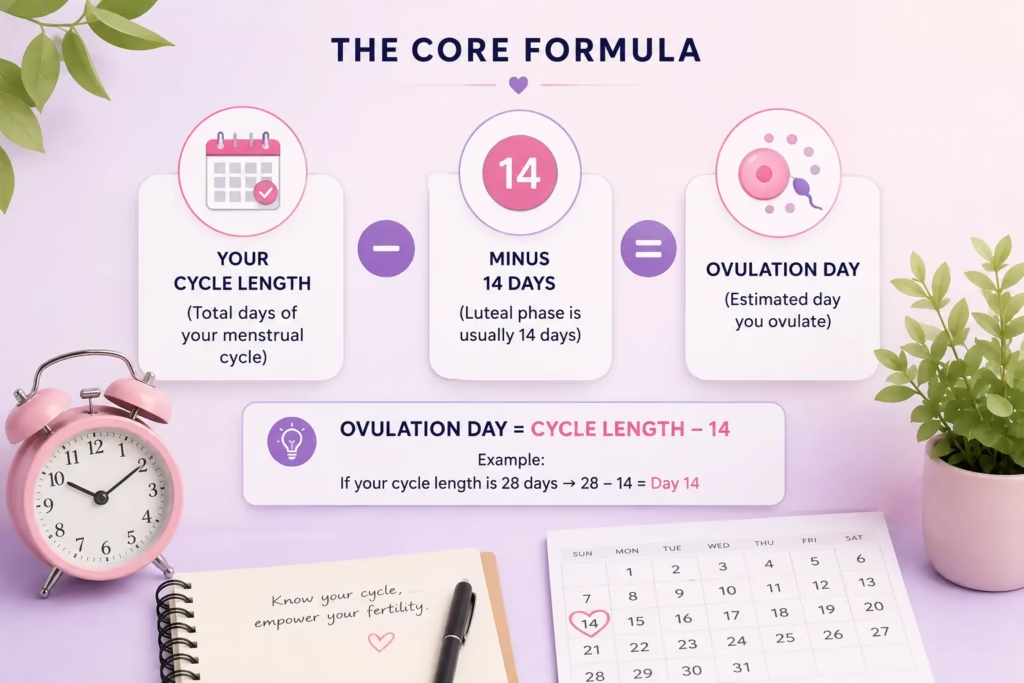
The foundation of every ovulation date calculator is a straightforward formula based on two pieces of information you already know: the first day of your last menstrual period and your average cycle length.
The Ovulation Formula
Ovulation Date equals First Day of Last Period plus Cycle Length minus 14 days.
The 14 days represent the luteal phase, which is the time between ovulation and the start of the next period. The luteal phase is remarkably consistent across most women at approximately 14 days, regardless of total cycle length. This consistency is what makes the formula reliable.
Why Subtract 14 Days
Ovulation does not happen at the midpoint of your cycle. It happens 14 days before your next period begins. In a 28-day cycle, subtracting 14 from 28 gives day 14, which is the midpoint. But in a 32-day cycle, subtracting 14 from 32 gives day 18, not day 16. The formula always counts back from the end of the cycle, not forward from the beginning.
How to Calculate Ovulation Day — Step by Step
Here is the complete manual method for calculating your ovulation day.
Step One: Note the First Day of Your Last Period
Find the exact date your most recent period began. This is the first day of actual bleeding, not spotting. Write this date down clearly with the day, month, and year.
Step Two: Determine Your Average Cycle Length
Your cycle length is the number of days from the first day of one period to the day before your next period begins. If you have been tracking your periods, add up the lengths of your last three cycles and divide by three to get your average.
For example, if your last three cycles were 29 days, 28 days, and 30 days, add them together to get 87 days. Divide by 3 to get an average cycle length of 29 days.
If you have not been tracking, use 28 days as a starting estimate and refine it as you track more cycles over the coming months.
Step Three: Calculate Your Expected Next Period Date
Add your average cycle length to the first day of your last period. This gives you the expected start date of your next period.
For example, if your last period started on April 1 and your cycle is 29 days, your next period is expected around April 30.
Step Four: Subtract 14 Days to Find Ovulation Day
Subtract 14 days from your expected next period date. This gives your predicted ovulation day.
In the example above, April 30 minus 14 days gives April 16 as the predicted ovulation day.
Step Five: Identify Your Fertile Window
Your fertile window includes the five days before your predicted ovulation day and the ovulation day itself. In the example above, the fertile window runs from April 11 to April 16.
The most fertile days within this window are April 14, April 15, and April 16, which are the two days before ovulation and the day itself.
How to Calculate Ovulation Date for Different Cycle Lengths
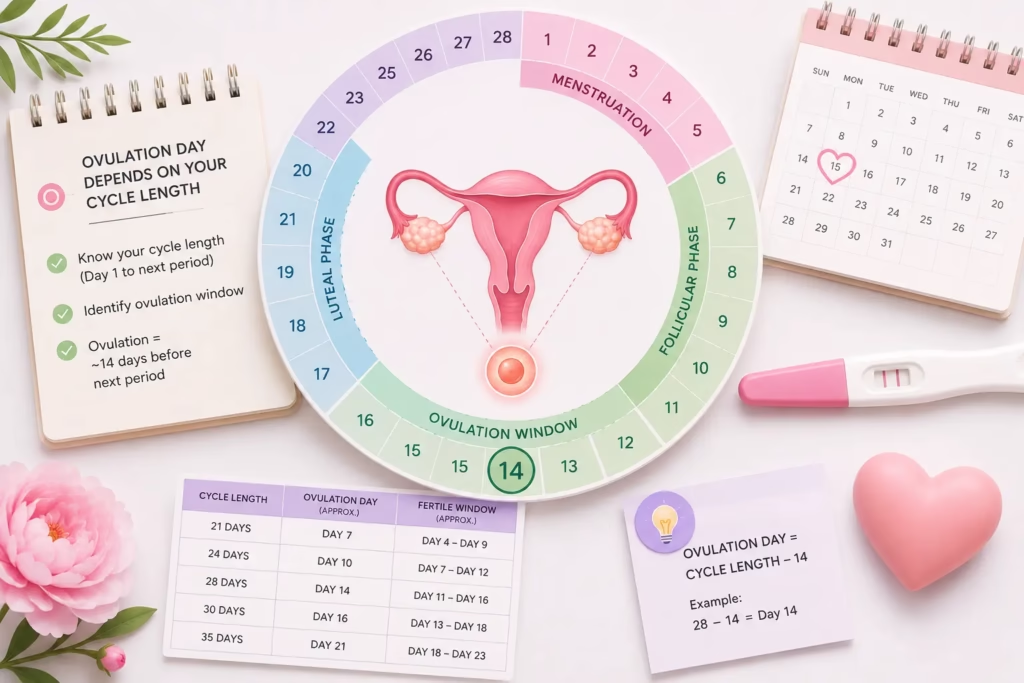
The formula works for any cycle length. Here is how the predicted ovulation day changes based on common cycle lengths.
21-Day Cycle
Last period: April 1. Next period expected: April 22. Ovulation day: April 22 minus 14 days equals April 8. Fertile window: April 3 to April 8.
25-Day Cycle
Last period: April 1. Next period expected: April 26. Ovulation day: April 26 minus 14 days equals April 12. Fertile window: April 7 to April 12.
28-Day Cycle
Last period: April 1. Next period expected: April 29. Ovulation day: April 29 minus 14 days equals April 15. Fertile window: April 10 to April 15.
30-Day Cycle
Last period: April 1. Next period expected: May 1. Ovulation day: May 1 minus 14 days equals April 17. Fertile window: April 12 to April 17.
35-Day Cycle
Last period: April 1. Next period expected: May 6. Ovulation day: May 6 minus 14 days equals April 22. Fertile window: April 17 to April 22.
This demonstrates why women with longer cycles ovulate later in their cycle than those with shorter cycles, and why assuming a standard day 14 ovulation is inaccurate for most women.
Ovulation Day Calculator — Quick Reference by Cycle Length
Here is a quick reference table showing estimated ovulation days for common cycle lengths.
Cycle Length | Expected Ovulation Day |
|---|---|
21 days | Day 7 |
24 days | Day 10 |
26 days | Day 12 |
28 days | Day 14 |
30 days | Day 16 |
32 days | Day 18 |
35 days | Day 21 |
Use this table as a quick guide. For your exact predicted ovulation date based on your personal last period date and cycle length, use our free ovulation calculator for an instant personalized result.
How to Calculate Ovulation — Manual vs Calculator
Many women calculate their ovulation day manually using a calendar and the formula above. This works well for regular cycles and gives you a solid understanding of your own fertility pattern. However, manual calculation has some limitations.
Manually tracking days across month boundaries requires careful counting. February has 28 or 29 days, and other months vary between 30 and 31 days. One wrong day count shifts your entire fertile window by a day. For most women, using an ovulation date calculator alongside manual tracking gives the most reliable result, because the calculator handles all the date arithmetic automatically while you focus on understanding your cycle.
How to Calculate Ovulation If Your Cycles Are Not Regular
The standard formula assumes your cycle length is consistent from month to month. If your cycles vary by more than a few days, the formula still works, but gives a range rather than a single day.
Using a Range for Irregular Cycles
If your cycles vary between 26 and 32 days, calculate your ovulation day for both extremes. For a 26-day cycle, ovulation falls around day 12. For a 32-day cycle, ovulation falls around day 18. Your actual ovulation falls somewhere within this range each cycle.
This wider window means you need to be prepared for a longer fertile window than women with regular cycles. Tracking physical signs of ovulation alongside the formula helps you identify where within this range your actual ovulation falls in any given cycle.
Physical Signs to Confirm Ovulation Day
Cervical mucus becomes clear, stretchy, and slippery, similar to raw egg white, in the days leading up to ovulation. This is one of the most reliable physical signs that ovulation is approaching.

Basal body temperature rises by approximately 0.2 to 0.5 degrees Celsius after ovulation has occurred. Tracking this daily confirms that ovulation has happened, though it cannot predict it in advance.
Ovulation test kits detect the surge in luteinizing hormone that occurs 24 to 36 hours before ovulation. A positive test means ovulation is likely within the next one to two days, giving you advance notice to time intercourse effectively.
Why Ovulation Day Calculation Is More Useful Than You Think
Many women assume that ovulation is easy to identify through symptoms alone. In reality, ovulation symptoms are subtle and not always present in every cycle. Calculating your ovulation day using your cycle data gives you a reliable prediction even when symptoms are unclear or absent.
Knowing your predicted ovulation day also helps you understand your cycle better over time. As you track your last period date and cycle length each month and compare the predictions with your physical signs, you build a more accurate picture of your personal fertility pattern. This makes each subsequent calculation more reliable than the last.
Questions About Ovulation Calculations
Use our free ovulation calculator to find your predicted ovulation date, fertile window, and best days to conceive instantly.
Medical Disclaimer
This guide and the ovulation calculator provide estimates based on average cycle patterns and standard luteal phase calculations. Results are for informational purposes only and should not replace professional medical advice. Ovulation timing varies between individuals and can be affected by health conditions and other factors. Consult a qualified healthcare provider for personalized fertility guidance.